

Recent work
This page highlights selected recent work from the lab, spanning brain-inspired computing, neuromorphic intelligence, and related research directions.
It offers a concise overview of our recent research efforts and representative results.
Filter by tag
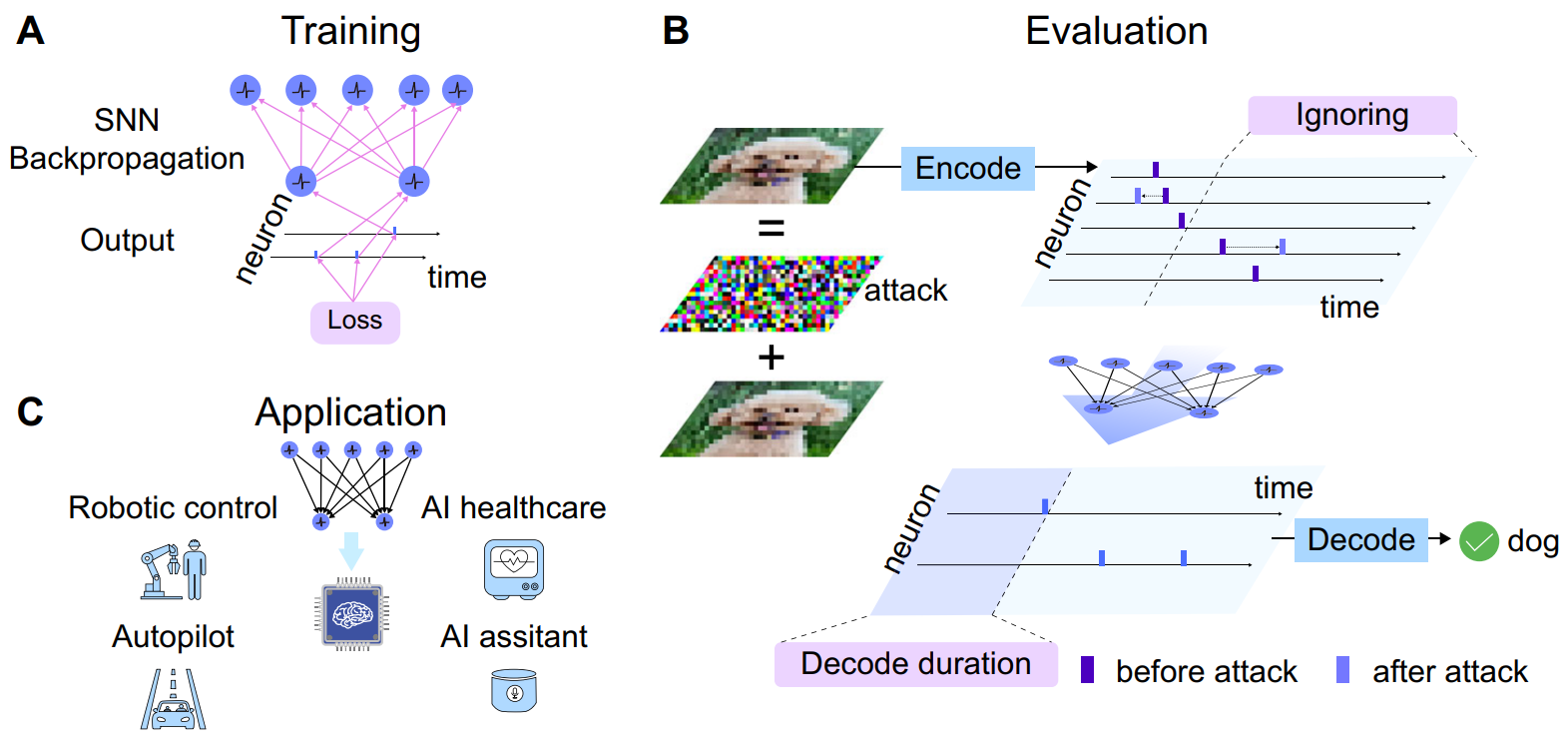
Neuromorphic Computing Paradigms Enhance Robustness through Spiking Neural Networks
Experimental results on datasets such as CIFAR-10 show that the proposed SNN-based methods significantly outperform conventional ANNs in adversarial settings, achieving up to twice the robustness. At the same time, the model maintains high energy efficiency, making it suitable for real-world safety-critical and resource-constrained applications.
在 CIFAR-10 等数据集上的实验结果表明,所提出的基于 SNN 的方法在对抗攻击场景下显著优于传统 ANN,鲁棒性最高可提升至两倍。同时,该模型依然保持较高的能效,适用于真实世界中对安全性要求较高且资源受限的应用场景。
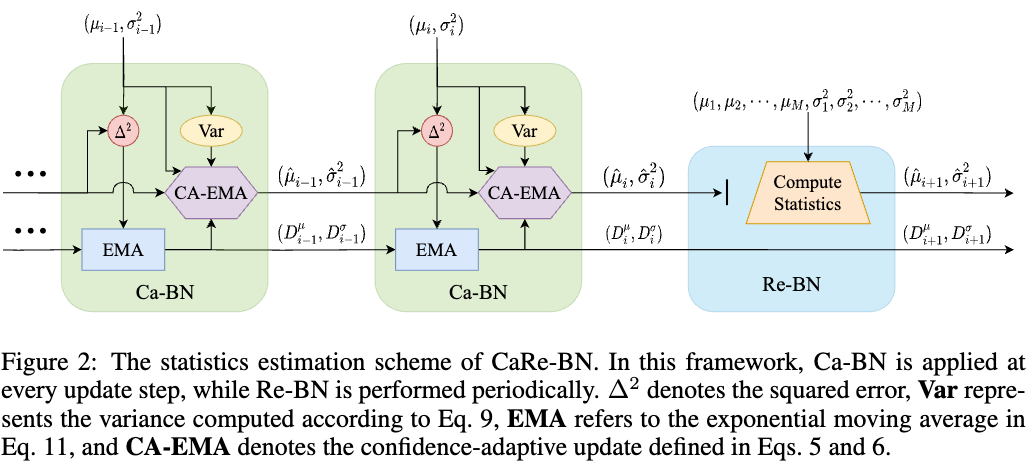
CaRe-BN: Precise Moving Statistics for Stabilizing Spiking Neural Networks in Reinforcement Learning
Extensive evaluations across discrete action spaces (Atari benchmarks) and continuous control tasks (MuJoCo suite) demonstrate that CaRe-BN significantly resolves the issue of imprecise moving statistics. SNN-based agents equipped with CaRe-BN consistently achieved higher exploration returns, converged faster, and exhibited significantly lower variance compared to standard SNNs. Notably, when paired with the TD3 algorithm, CaRe-BN allowed simple SNNs to surpass the performance of traditional ANN-based RL agents by an average of 5.9%, establishing a new state-of-the-art normalization strategy that bridges the gap between neuromorphic efficiency and high-performance RL.
在离散动作空间(Atari 基准)和连续控制任务(MuJoCo 套件)上的广泛实验表明,CaRe-BN 能够显著缓解移动统计量不精确的问题。配备 CaRe-BN 的 SNN 智能体在探索回报、收敛速度和方差表现上均优于标准 SNN。尤其是在与 TD3 算法结合时,CaRe-BN 使简单 SNN 的平均性能超过传统基于 ANN 的强化学习智能体 5.9%,建立了一种连接神经形态高能效与高性能强化学习的新型归一化策略。
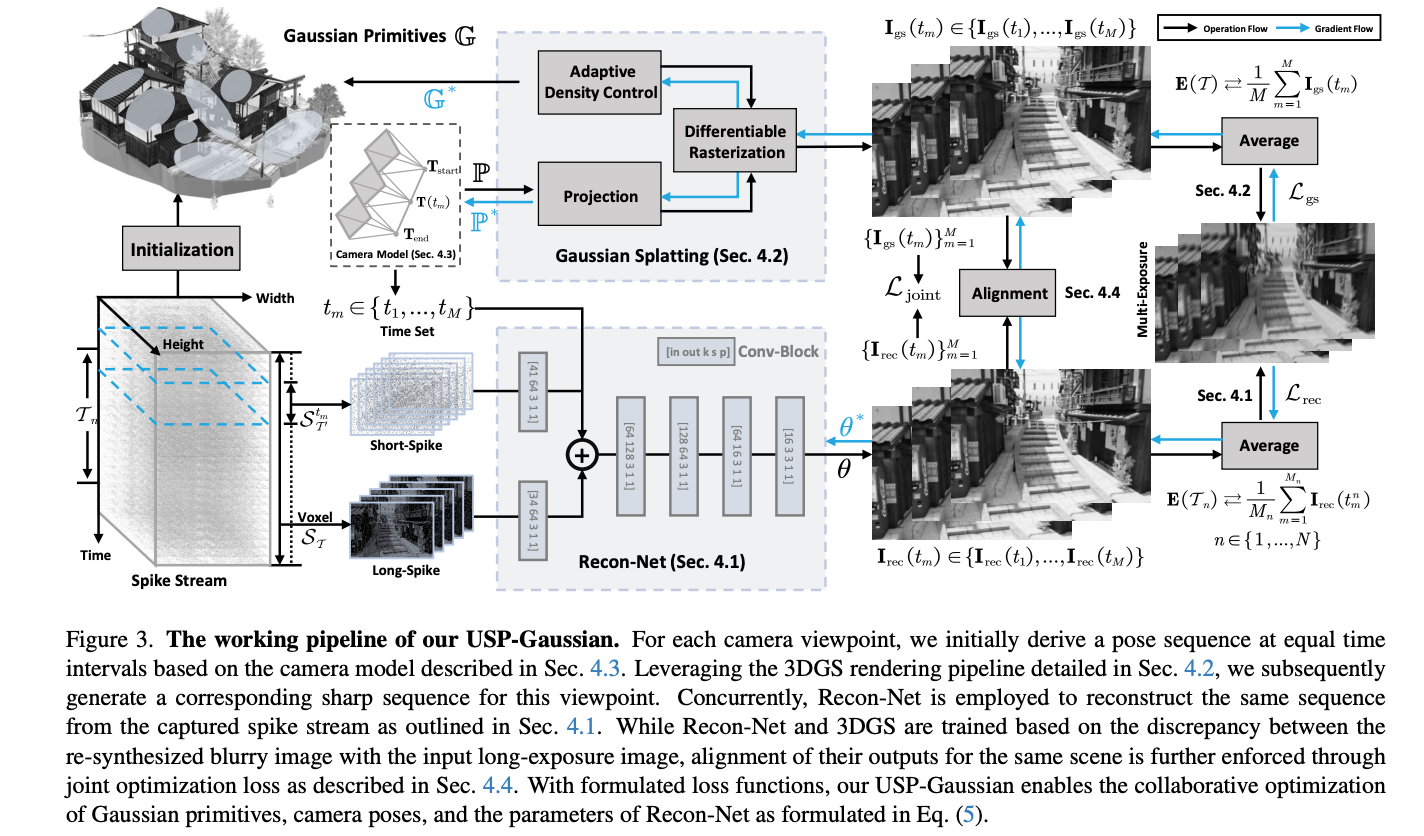
USP-Gaussian: Unifying Spike-based Image Reconstruction, Pose Correction and Gaussian Splatting
Extensive experiments on both synthetic and real-world datasets show that USP-Gaussian consistently outperforms prior spike-based reconstruction methods. On the synthetic benchmark, the paper reports an average performance of 27.903 PSNR / 0.843 SSIM / 0.217 LPIPS, surpassing the main baseline SpikeGS, which achieves 27.196 / 0.832 / 0.244. In particular, on the Outdoorpool scene, USP-Gaussian reaches 30.142 dB PSNR, which is the best result in the table. These results verify that unified optimization substantially alleviates the error accumulation problem in cascaded pipelines.
在合成数据集和真实数据集上的大量实验表明,USP-Gaussian 持续优于此前的基于脉冲的重建方法。在合成基准上,论文报告的平均性能达到 27.903 PSNR / 0.843 SSIM / 0.217 LPIPS,优于主要基线 SpikeGS 的 27.196 / 0.832 / 0.244。尤其是在 Outdoorpool 场景中,USP-Gaussian 取得了 30.142 dB 的 PSNR,为表中最优结果。这些结果验证了统一优化能够显著缓解级联流程中的误差累积问题。
For the complete publication list, visit our publications page.