

USP-Gaussian: Unifying Spike-based Image Reconstruction, Pose Correction and Gaussian Splatting
Kang Chen, Jiyuan Zhang, Zecheng Hao, Yajing Zheng, Tiejun Huang, Zhaofei Yu. USP-Gaussian: Unifying Spike-based Image Reconstruction, Pose Correction and Gaussian Splatting. Proceedings of the Computer Vision and Pattern Recognition Conference (CVPR), 2025. (Highlight).*
Research Background and Problem
Background
Spike cameras are neuromorphic sensors that record scenes as high-temporal-resolution binary streams, making them highly suitable for 3D reconstruction and novel view synthesis in high-speed dynamic scenarios.
Limitation of Existing Methods
Existing spike-based 3D reconstruction methods usually adopt a cascaded three-stage pipeline – spike-to-image reconstruction, pose estimation, and 3D reconstruction – which suffers from severe error accumulation because inaccuracies in early reconstruction directly degrade downstream pose estimation and rendering quality.
Our Perspective
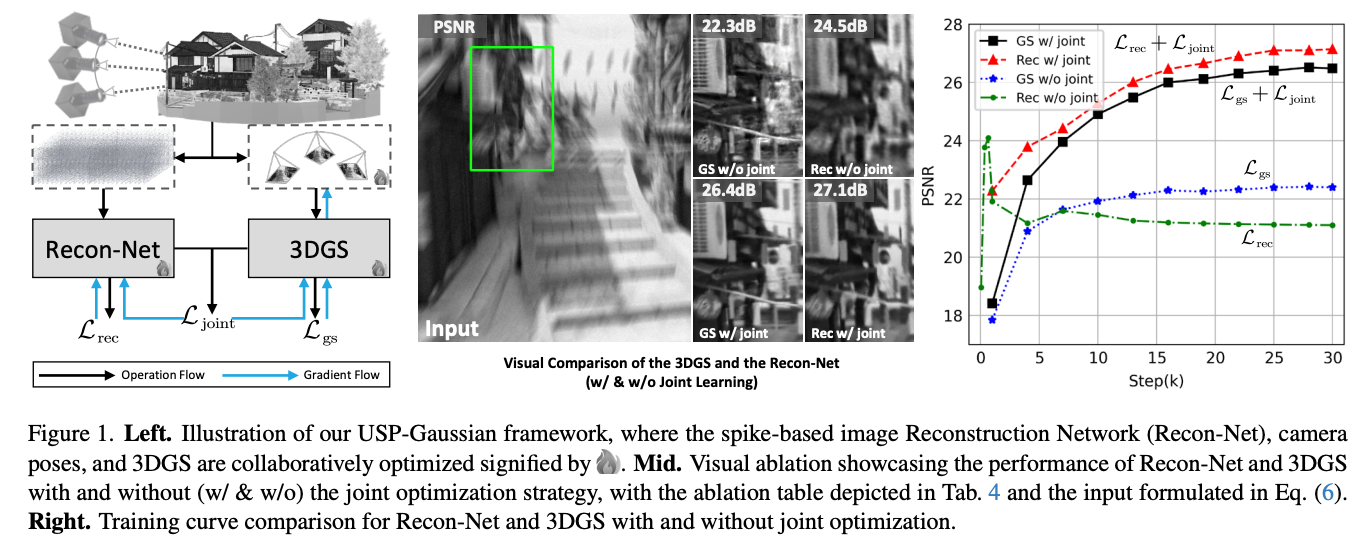
To address this issue, USP-Gaussian proposes a unified framework that jointly optimizes spike-based image reconstruction, pose correction, and Gaussian splatting in an end-to-end manner. By allowing these components to mutually supervise and refine each other during training, the method effectively reduces the error propagation inherent in conventional cascaded pipelines.
Contributions
- Proposes USP-Gaussian, a unified framework that jointly integrates spike-based image reconstruction, camera pose correction, and 3D Gaussian Splatting, instead of treating them as independent sequential stages.
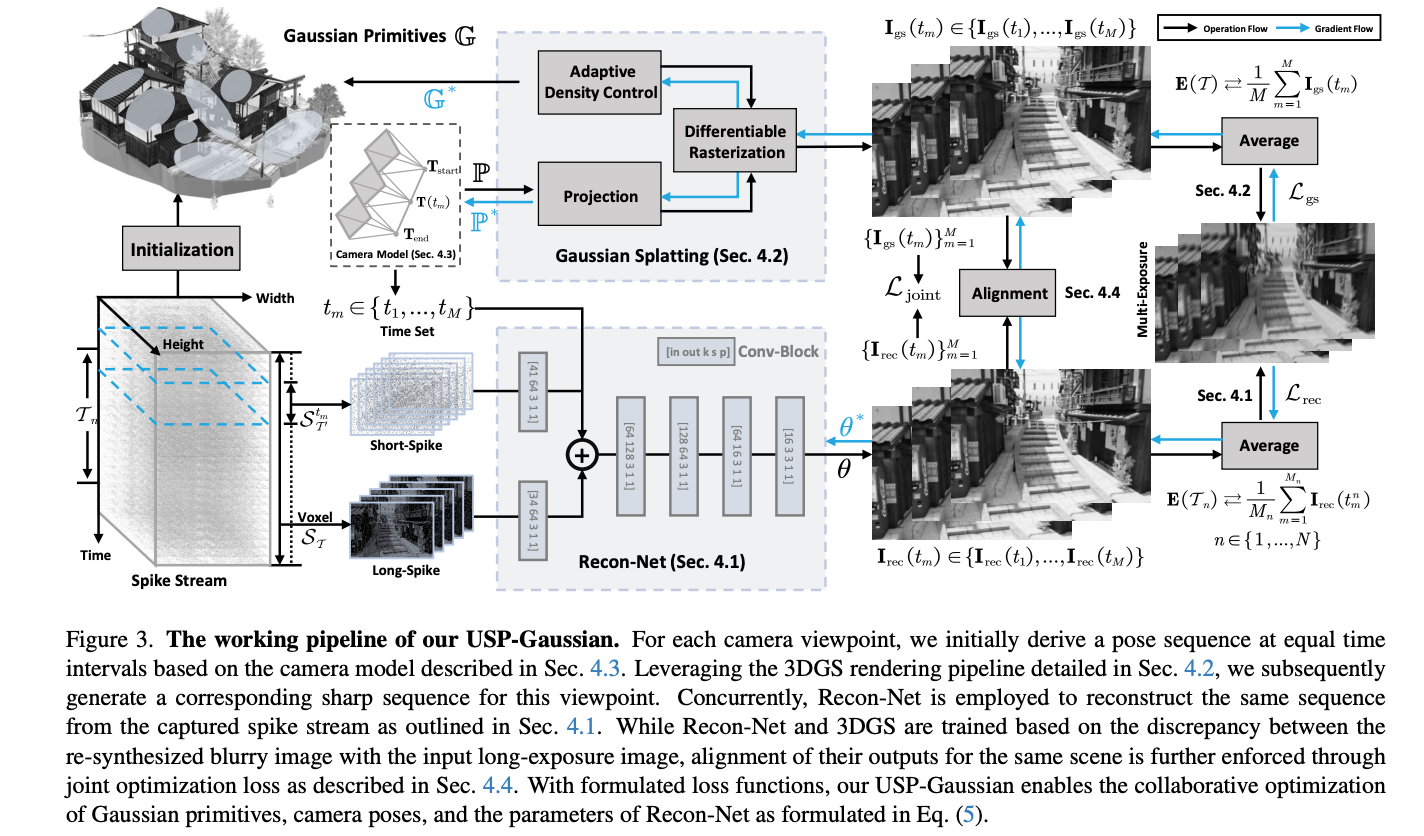
- Introduces a joint optimization strategy that aligns the reconstructed image sequence from Recon-Net with the rendered sequence from 3DGS, enabling reconstruction and 3D representation learning to provide complementary supervision to each other.
- Establishes a new self-supervised spike reconstruction paradigm by using multi-view consistency from 3DGS as an additional supervisory signal, rather than relying only on isolated spike-to-image reconstruction objectives.
- Designs complementary long-short spike inputs and a multi-reblur loss, which improve reconstruction robustness under low spike firing rates, suppress noise, and prevent the model from collapsing to a trivial long-exposure prediction.
Core Method
The core idea of USP-Gaussian is to jointly train two tightly coupled branches. The first branch is Recon-Net, which takes spike streams as input and reconstructs a sequence of sharp images. Instead of using only a short spike window, the method feeds long spikes, short spikes, and a time index into the network so that both global and local temporal information can be exploited, especially under low-texture or low-firing-rate conditions. The second branch is 3D Gaussian Splatting, which uses the current Gaussian primitives and camera poses to render a sharp image sequence over the exposure interval. These two branches are optimized both individually and jointly, so that they can progressively improve each other during training.
Representative Results
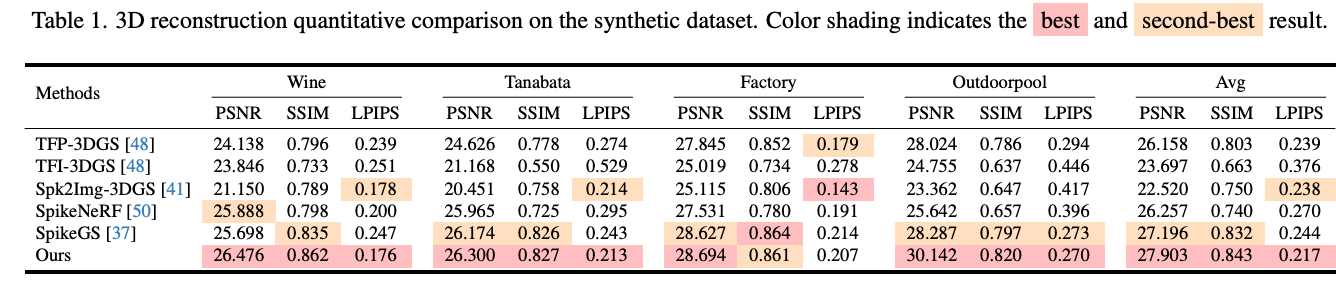
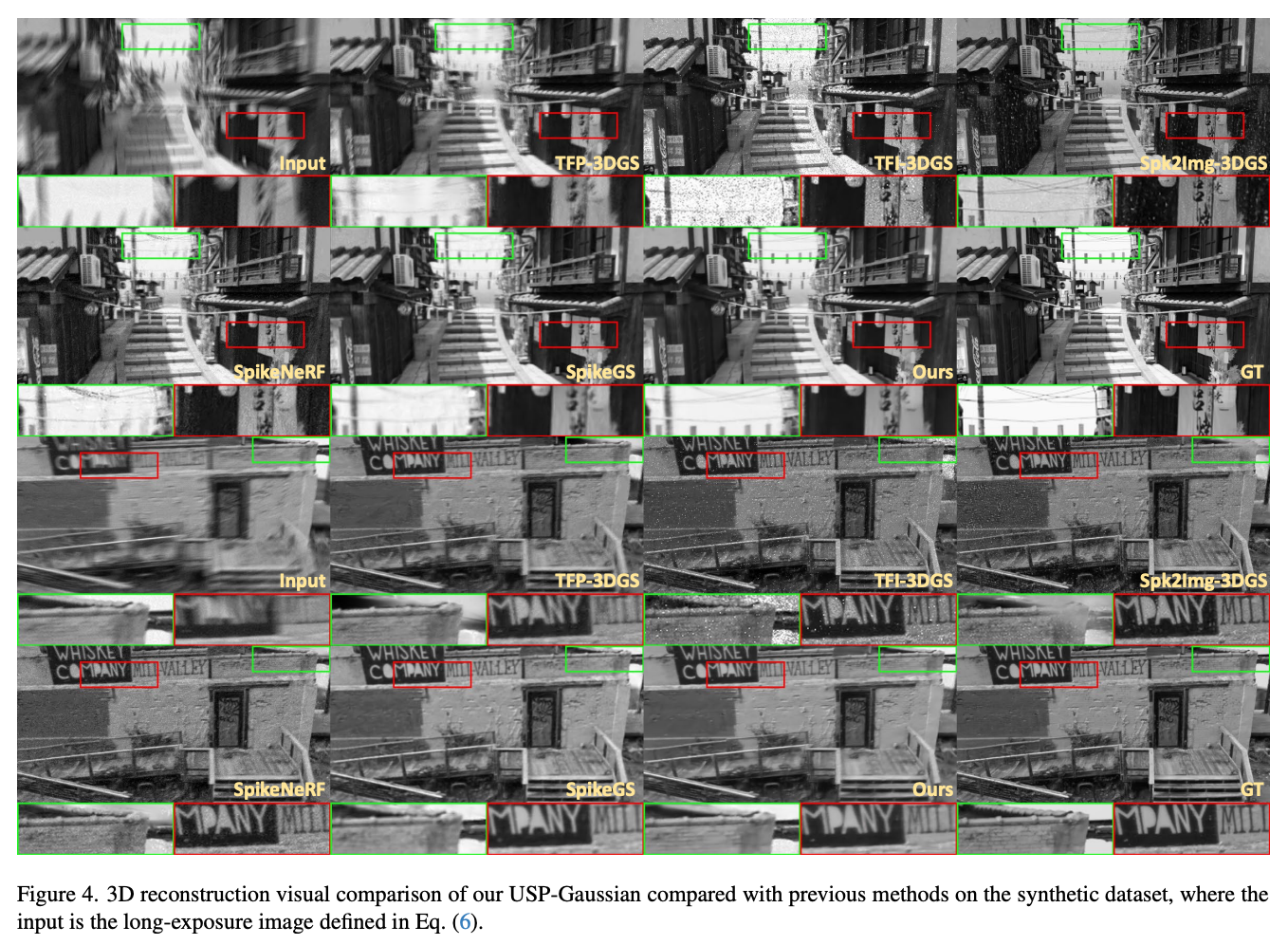
Extensive experiments on both synthetic and real-world datasets show that USP-Gaussian consistently outperforms prior spike-based reconstruction methods. On the synthetic benchmark, the paper reports an average performance of 27.903 PSNR / 0.843 SSIM / 0.217 LPIPS, surpassing the main baseline SpikeGS, which achieves 27.196 / 0.832 / 0.244. In particular, on the Outdoorpool scene, USP-Gaussian reaches 30.142 dB PSNR, which is the best result in the table. These results verify that unified optimization substantially alleviates the error accumulation problem in cascaded pipelines.
研究背景与问题
背景
脉冲相机是一类神经形态传感器,能够以高时间分辨率的二值流形式记录场景,因此非常适合用于高速动态场景下的三维重建与新视角合成。
现有方法的局限
现有基于脉冲的三维重建方法通常采用“脉冲到图像重建、位姿估计、三维重建”三级级联流程。由于前期重建中的误差会直接削弱后续位姿估计与渲染质量,这类方法往往面临严重的误差累积问题。
我们的思路
为了解决这一问题,USP-Gaussian 提出一个统一框架,以端到端方式联合优化基于脉冲的图像重建、位姿校正与 Gaussian Splatting。通过在训练过程中让这些模块相互监督、相互修正,该方法能够有效缓解传统级联流程中固有的误差传播问题。
创新点
- 提出 USP-Gaussian 统一框架,将基于脉冲的图像重建、相机位姿校正与 3D Gaussian Splatting 联合建模,而不再将其视为彼此独立的串行阶段。
- 引入联合优化策略,对齐 Recon-Net 重建得到的图像序列与 3DGS 渲染序列,使图像重建与三维表示学习能够为彼此提供互补监督。
- 利用 3DGS 的多视角一致性作为额外监督信号,建立新的自监督脉冲重建范式,而不再仅依赖孤立的 spike-to-image 重建目标。
- 设计长短时互补的脉冲输入以及 multi-reblur loss,在低脉冲发放率条件下提升重建鲁棒性、抑制噪声,并避免模型退化为简单的长曝光预测。
核心方法
USP-Gaussian 的核心思想是联合训练两个紧密耦合的分支。第一个分支是 Recon-Net,它以脉冲流为输入并重建清晰图像序列。与仅使用短时间窗脉冲不同,该方法同时输入长时脉冲、短时脉冲以及时间索引,从而能够同时利用全局与局部时间信息,尤其适用于低纹理或低发放率场景。第二个分支是 3D Gaussian Splatting,它基于当前的高斯元与相机位姿,在曝光时间内渲染清晰图像序列。这两个分支既分别优化,也联合优化,从而在训练过程中逐步相互促进、共同提升。
代表性结果
在合成数据集和真实数据集上的大量实验表明,USP-Gaussian 持续优于此前的基于脉冲的重建方法。在合成基准上,论文报告的平均性能达到 27.903 PSNR / 0.843 SSIM / 0.217 LPIPS,优于主要基线 SpikeGS 的 27.196 / 0.832 / 0.244。尤其是在 Outdoorpool 场景中,USP-Gaussian 取得了 30.142 dB 的 PSNR,为表中最优结果。这些结果验证了统一优化能够显著缓解级联流程中的误差累积问题。